How to Start a Gospel Music Career in Nigeria — What It Actually Takes
BY GMUSICVIBES EDITORIAL
Published Jun 29, 2026
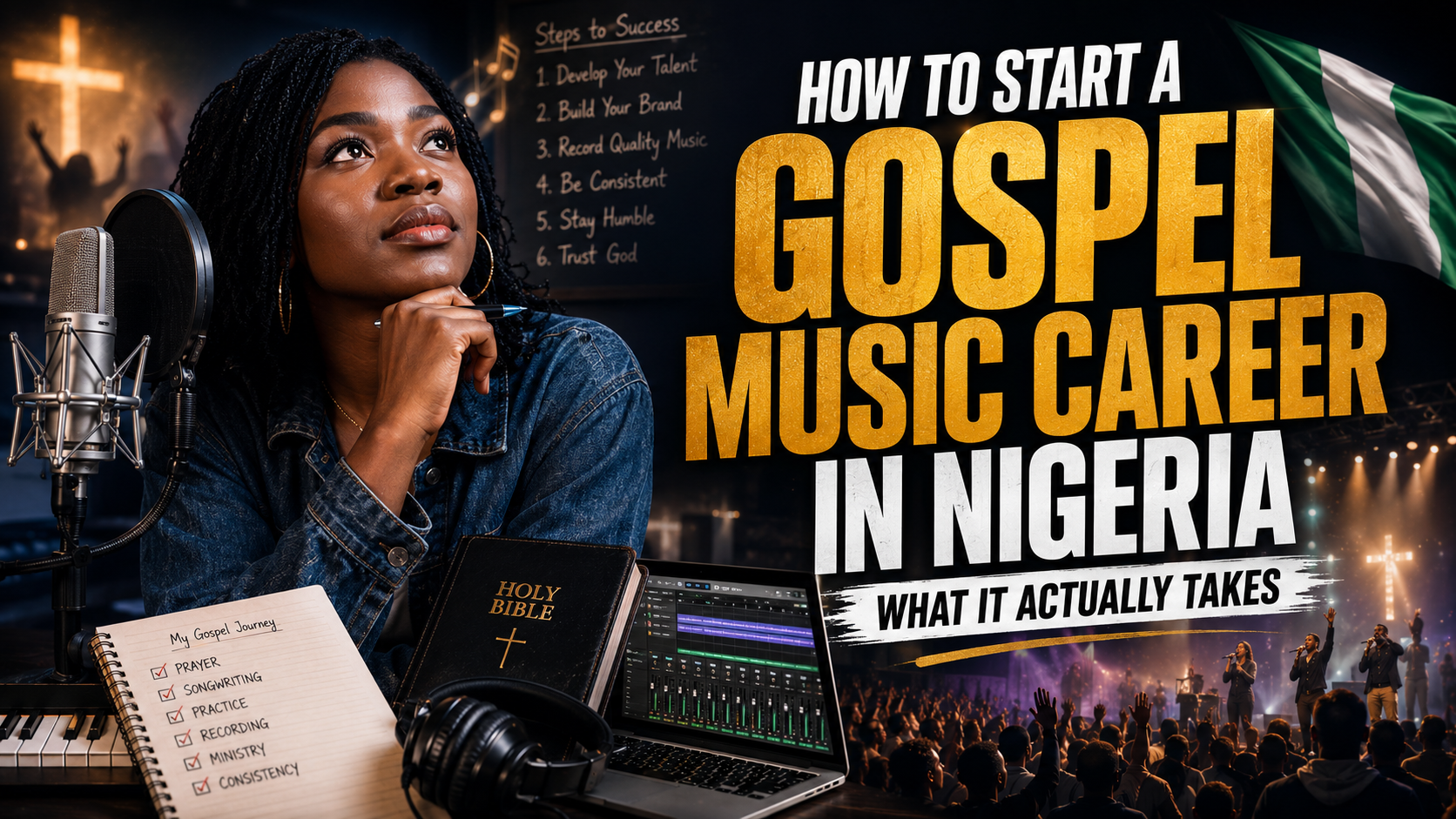
An honest walk through the path from church choir to recording
artist, including the parts nobody warns you about.
Almost every Nigerian gospel
artist with any real staying power tells some version of the same origin story.
They started in a church choir, usually as a child or teenager. Someone
noticed. They got handed a solo. Something shifted in the room when they sang
it.
Mercy Chinwo's path ran through
a televised talent competition before her debut album made her name. Chioma
Jesus was a petty food trader who built an entire ministry on Igbo-language
worship after years in a local church choir. Tasha Cobbs didn't even sing
publicly until fifteen, stepping in only because a scheduled soloist failed to
show up. None of them set out with a five-year plan. They started serving in a
room, and the room is where everything else eventually grew from.
That's the real starting point
for almost everyone in this genre, and it's worth saying plainly before
anything else: there is no shortcut around it. But starting in the choir is
only the beginning. Here's what the rest of the path actually looks like,
including the parts most advice on this topic skips.
Step One: Get Genuinely Good Before You Get Visible
The instinct for a lot of new
artists is to record something and push it out immediately — get a single on
every platform, build a following, figure out the music later. That instinct is
backwards, and the gospel space punishes it more visibly than most genres
because the audience is unusually attuned to sincerity versus performance.
Spend real time first. Sing in
your church choir, not as a stepping stone to leave behind but as an actual
training ground. Learn an instrument if you don't already — even basic piano or
guitar changes how you write, because you stop being entirely dependent on
someone else to translate what's in your head into something playable. Study
the artists who came before you specifically, not just to imitate them but to
understand what they were actually doing structurally. Listen to how Nathaniel
Bassey uses space and silence as much as melody. Notice how Tope Alabi's
phrasing mirrors actual Yoruba speech patterns rather than imposing foreign
vocal stylings onto the language.
This stage takes longer than
anyone wants it to. There's no real way to compress it.
Step Two: Understand That Gospel Music Is Both a Ministry and a Business,
Simultaneously
This is the part that catches a
lot of new artists off guard, and it's worth being unusually direct about it.
Nigerian gospel singer Lara
George sparked a public debate when she challenged the double standard she saw
in how audiences treated payment — critics who expected Nigerian gospel artists
to perform for free while quietly accepting that foreign gospel artists charged
substantial fees for the same kind of ministry. That tension doesn't resolve
cleanly, and you'll have to find your own position on it. But you cannot enter
this space assuming it operates purely as ministry with no commercial
dimension. It doesn't. Studio time costs money. Distribution costs money. If
you eventually tour, logistics cost real money. Treating the business side as
something beneath your calling, rather than something that sustains your
calling, is one of the more common ways promising artists stall out financially
within a few years.
At the same time, audiences in
this genre can tell, often within seconds, when a song was written primarily to
be commercially successful rather than because the artist had something true
they needed to say. Holding both things — genuine spiritual conviction and
basic commercial competence — without letting either one swallow the other, is
the actual skill here. It's harder than it sounds, and it's a skill you'll keep
refining for your entire career, not something you solve once.
Step Three: Use the Infrastructure That Didn't Exist a Decade Ago
Here's the genuinely good news,
and it's a recent development that older generations of gospel artists simply
didn't have access to.
Independent artists like
Greatman Takit and Limoblaze have built substantial audiences — millions of
listeners — entirely through YouTube, Spotify, and TikTok, without ever signing
to a major gospel label. That route didn't meaningfully exist fifteen years
ago. Getting heard used to require label backing, radio relationships, or
physical distribution through church networks. Now it requires a phone, a
half-decent microphone, and consistency.
Practically, that means: get
your music onto every major streaming platform through a distributor — there
are several that work well for African artists and don't require label backing.
Build a consistent presence on whichever platform your specific audience
actually uses, rather than spreading thin across every platform equally. Treat
short-form video seriously; it has become one of the single most effective
discovery mechanisms for new gospel artists, the same way it was for Forrest
Frank and Brandon Lake's recent American crossovers. None of this replaces the
music itself. But ignoring it means leaving most of your potential audience
undiscovered, simply because they were never going to find you any other way.
Step Four: Protect Your Work Before You Need To
This is the step almost nobody
talks about until something has already gone wrong, and by then it's usually
too late to fix cleanly.
Songwriting credit and
copyright disputes have surfaced repeatedly in gospel music as the genre has
scaled commercially — situations where the question of who actually wrote and
owns a song became a serious legal and financial fight, sometimes years after
the song had already become a hit. These disputes aren't really new to music as
a whole, but gospel artists, especially newer ones operating without formal
management or legal guidance, are particularly exposed to them. A handshake
agreement with a producer, an informal understanding about who owns what
percentage of a collaboration, an assumption that 'we're all believers, this
will work itself out' — these are the exact conditions under which expensive
disputes happen later.
Get songwriting credits and
ownership splits in writing before a song is released, not after it becomes
successful. It feels unnecessary and slightly awkward to ask for this early,
particularly with people you trust and worship alongside. Do it anyway. The
artists who skip this step are disproportionately the ones who end up in the
kind of public, painful disputes that damage both their finances and their
testimony years into an otherwise successful career.
Step Five: Decide What Kind of Artist You Actually Want to Be — Early
There isn't one template for a
successful gospel career anymore, and that's a real opportunity if you take it
seriously early rather than drifting into a lane by accident.
Some artists build their entire
identity around congregational worship — music genuinely meant to be sung by a
room of people, not necessarily to chart commercially. Others, like Tim Godfrey
or the Afro-gospel artists blending Christian lyrics with Afrobeats production,
are building something closer to mainstream pop careers with explicit spiritual
content. Both are legitimate. Both require different skills, different
collaborators, and different definitions of success. The mistake is trying to
be both simultaneously without ever deciding, which tends to produce music that
doesn't fully satisfy either audience.
Ask yourself honestly, early,
what you're actually building toward. A worship leader's career looks different
from a gospel pop artist's career, which looks different again from someone
building primarily around live ministry and crusades rather than recorded
output. None of these is more spiritual than the others. But pursuing all three
at once, without clarity, is usually how a young artist ends up directionless
five years in, wondering why nothing has quite taken off despite genuine
talent.
Step Six: Build Real Relationships, Not Just a Following
Every artist profiled across
this entire blog so far got somewhere, at some point, because of a specific
relationship — not an algorithm, not a viral moment, an actual person who
opened a door.
Tasha Cobbs had Pastor William
Murphy publicly declaring she was 'a bridge to the nations' years before that
prophecy made literal sense. Chioma Jesus built a close mentorship relationship
with Mercy Chinwo, whom she now calls a daughter. Mercy Chinwo's own
breakthrough came through a competition that put her in front of an entire
industry at once. None of these relationships were transactional networking
exercises. They were built through years of actual shared ministry, mutual
respect, and consistency.
This is slower and less
controllable than building a social media following, and that's exactly why it
matters more in the long run. A following can evaporate when a platform's
algorithm shifts. A genuine relationship with a mentor, a producer, a more
established artist who believes in what you're doing — that tends to outlast
every platform change the industry throws at it.
The Honest Timeline
If you're hoping for a
realistic sense of how long this actually takes: most of the artists covered
across this blog spent somewhere between five and fifteen years in relative
obscurity — singing in choirs, releasing independent projects that went mostly
unnoticed, building skill and relationships quietly — before anything
resembling a breakthrough happened. Sinach had been writing songs for over a
decade before Way Maker found its global moment. Nathaniel Bassey had built a
substantial reputation within Nigerian gospel circles for years before the
Hallelujah Challenge introduced him to a different scale of audience entirely.
There is no version of this
advice that compresses that timeline into something faster. What you can
control is whether those years are spent building genuine skill, genuine
relationships, and genuine spiritual depth, or spent chasing shortcuts that
tend to produce shallow, short-lived attention instead. The slow path is,
frustratingly, also the only path that has consistently worked for the artists
who lasted.
Are you
working on your own gospel music journey right now? I'd love to hear where
you're at and what's been hardest about it so far — share in the comments.
Discussion (0)
No comments yet. Be the first to share your thoughts!