Is Dancing in Church Biblical? The Theology and History Behind Gospel's Most Physical Worship Traditions
BY GMUSICVIBES EDITORIAL
Published Jul 19, 2026
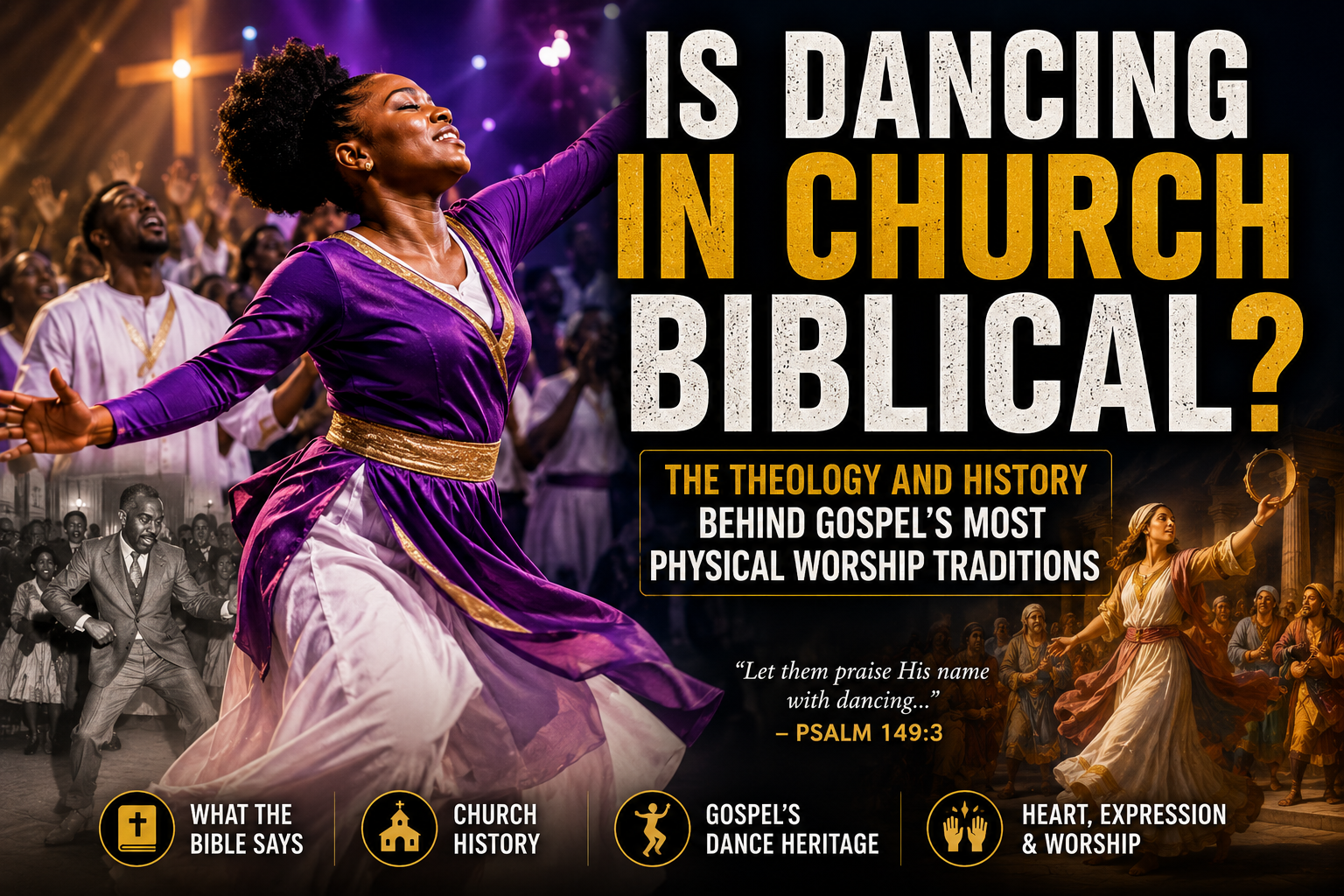
The short answer is yes. But the longer answer involves
missionaries who banned drums, the Aladura churches who ignored them, David
doing something that made his wife furious, and the Nigerian Pentecostal
tradition that made dancing in church feel obvious to an entire generation.
There are still churches in Nigeria where dancing during worship would raise eyebrows. There are also churches where if you are not dancing, people will assume something is wrong with you spiritually. Same country, same Bible, very different conclusions about what the body is supposed to do when God shows up.
This is worth thinking through
carefully. Not because there's one correct answer that settles the debate
forever, but because both sides of this conversation are often talking past
each other — one invoking reverence without explaining what reverence requires
physically, the other invoking the Spirit without asking whether every movement
in a service is actually Spirit-led or just emotionally energised. Both
criticisms have some purchase. Neither is entirely right.
Let me start with what the
Bible actually says, then trace how dancing ended up in Nigerian churches
specifically, and then say something honest about what the genuine concerns on
both sides are.
What the Bible Actually Says
Nowhere in scripture does God
prohibit dancing in worship. That's the first thing to establish plainly. The
prohibition tradition in many churches came from European Christianity, not
from the Bible itself.
What the Bible does say,
repeatedly, is the opposite. Miriam took a tambourine and led the women in
dancing after God parted the Red Sea — Exodus 15:20. Psalm 149:3 says
explicitly to praise his name with dancing. Psalm 150, the final psalm in the
entire book of Psalms, lists dancing alongside instruments as a legitimate form
of praise. The psalmist in Psalm 30:11 describes God turning mourning into
dancing. These aren't peripheral references. Dancing appears throughout the
Psalms as a normal, expected expression of praise.
Then there's David. Second
Samuel 6 records David dancing before the Ark of the Lord with everything he
had — leaping and whirling before the Lord. His wife Michal watched from a
window and despised him for it. When David came home she told him he had
humiliated himself by dancing in front of servants and common people. David's
response was essentially: I was worshipping God, not performing for human
opinion, and I will become even more undignified than this. God then closes the
account by noting that Michal remained childless for the rest of her life —
which the text presents not as neutral information but as a consequence of her
contempt for David's worship.
That's a specific and pointed
passage. The person who thought dancing in worship was undignified and
inappropriate is presented as being wrong. The person dancing with abandon is
presented as the one in right standing. You don't have to build an entire
theology of dance from that single incident, but you also can't ignore what the
text is saying about it.
In the New Testament, no direct
command about dancing in worship appears — in either direction. What does
appear is Paul's instruction that everything be done decently and in order (1
Corinthians 14:40), which gets applied frequently to this question. But
decently and in order is a principle about the conduct of a church gathering
more broadly, not a specific prohibition of physical movement during praise.
Applying it as a ban on dancing requires a reading that the text itself doesn't
quite support.
How Dancing Got Banned From Nigerian Churches in the First Place
The answer here has nothing to
do with the Bible and everything to do with nineteenth-century European
missionaries.
When Christian missionaries
arrived in Nigeria in the 1800s, they brought their own worship culture with
them — specifically, a solemn, structured, European Protestant form of church
that had no framework for the kind of physical, musical, communal worship
practice that was already deeply embedded in African life. They also brought
explicit theological suspicion of African instruments and rhythms, which they
associated with paganism and what they called heathen worship.
The result was that early
Nigerian converts were taught to sing European hymns in English or other
European languages, often with harmonium accompaniment, in a style designed to
sound as different from traditional African music as possible. Drums were
discouraged or banned outright. Dancing was treated as worldly at best,
spiritually dangerous at worst. The assumption was that African physical
expressiveness in worship was a carryover from pre-Christian religious practice
and needed to be replaced rather than redeemed.
This created a lasting split in
Nigerian Christianity. The mainline missionary-planted churches — Anglican,
Methodist, Baptist — inherited that suspicion of physical expressiveness. Even
now, in ECWA, where it was formerly forbidden to shout 'Hallelujah,' the
posture toward energetic worship has shifted significantly — but those older
prohibitions shaped a generation of Christians who associated restrained
worship with theological seriousness and exuberant worship with spiritual
shallowness.
The Aladura Churches Changed Everything
The first major reversal came
not from the mainline churches revising their positions, but from entirely new
movements that simply started from different premises.
The Aladura churches — Cherubim
and Seraphim, Christ Apostolic Church, and others — emerged in south-west
Nigeria in the early twentieth century and explicitly rejected the European
missionary framework for worship. They reintroduced traditional African
instruments. They sang in Yoruba and other local languages. They brought back
call-and-response patterns, polyrhythms, percussion, and ecstatic dancing as
central features of their worship rather than things to be suppressed.
Their theology wasn't
dancing-for-its-own-sake. It was the conviction that God could be worshipped
through the whole person — including the body — and that African musical
tradition carried no inherent spiritual contamination requiring purification
before it could be used in Christian worship. The music was loud, energetic,
emotional, and charismatic. The dancing was visible and uninhibited. And it
grew. People who had been sitting through European-style hymn services found something
that resonated with how they actually experienced encounter with God, and the
Aladura churches became a significant force in Nigerian Christianity.
Pentecostalism Finished the Job
The Neo-Pentecostal wave that
swept through Nigeria from the 1970s onward took what the Aladura churches had
started and pushed it further into the mainstream. Winners' Chapel, Redeemed
Christian Church of God, Living Faith, Christ Embassy — these movements built
congregations that could number in the tens of thousands and whose worship
cultures were explicitly physical, energetic, and comfortable with dancing as a
normal part of encountering God.
By the time you reach the
Nigerian megachurch landscape of the 1990s and 2000s, dancing in church isn't
just permitted — it's expected. Not as performance and not as a departure from
reverence, but as an authentic expression of joy, of freedom, of the
theological conviction that God has done something worth moving your body over.
The influence of indigenous music — Yoruba rhythms specifically, but also
elements from across Nigeria's diverse musical traditions — shaped a worship
sound that was built for physical participation in a way that European hymns
structurally weren't.
This is why asking a Nigerian
Pentecostal Christian whether dancing in church is appropriate can genuinely
produce a puzzled expression. The question doesn't compute. Dancing is worship.
The body is part of the person. If the whole person is praising God, the body
is included. This isn't a position they've reasoned their way to from first
principles. It's the air they've been breathing since childhood.
The Legitimate Concerns on the Other Side
And yet the critics of dancing
in church aren't all wrong, and I think being honest requires saying so.
There are real and documented
cases of worship services where the atmosphere of physical expressiveness is
maintained by social pressure rather than spiritual movement — where not
dancing makes you conspicuous in a way that effectively compels participation
regardless of what is actually happening in your heart. That's not worship.
That's performance of worship, which is a different and more concerning thing.
There are also situations, less
common but real, where the musical and physical energy of a worship service
functions primarily as emotional stimulation — where people leave feeling
they've encountered God because they've had an intense experience, without
being able to distinguish between an emotionally charged environment and actual
spiritual substance. The nineteenth-century Baptist leader Charles Spurgeon was
making this point when he wrote that the music in some churches he visited had
the effect of producing a sensation that might be mistaken for spiritual
experience but was really just the result of rhythm and volume doing what
rhythm and volume do to human nervous systems.
These concerns are worth taking
seriously. Not because they settle the question against dancing — they don't.
But because the answer to 'is dancing in church biblical' is not simply 'yes'
and then no further questions. It's 'yes, and here are the conditions under
which physical expressiveness in worship is genuine rather than performative or
emotionally manufactured.'
The Honest Answer
Dancing in worship is biblical.
The evidence is unambiguous. God did not prohibit it, the Psalms actively
command it, and the history of the church's rejection of physical
expressiveness in worship is a history of European cultural assumptions being
mistaken for theological requirements.
The Nigerian Pentecostal
tradition, with all its roots in the Aladura movement's recovery of embodied
African worship, is not departing from scripture when it dances. It's actually
closer to the Psalms than the seated, solemn European Protestant tradition it
replaced.
What matters, as with
everything in worship, is the heart behind the movement. David danced because
he was genuinely undone with gratitude that the Ark was coming home. The women
who followed Miriam with tambourines had just watched the Egyptian army drown —
their dancing was the most natural and honest response possible to what they
had witnessed. When dancing in a church service comes from the same place —
genuine overflow of something real, rather than social expectation or emotional
stimulation dressed up as spiritual encounter — there is nothing in the Bible
that says God has a problem with it.
Michal did. And the text notes
clearly what happened to her.
How do
you personally experience dancing in worship — as natural expression, awkward
obligation, or something you're still working out? I'd genuinely love to hear
your perspective in the comments.
Discussion (0)
No comments yet. Be the first to share your thoughts!