"No Turning Back II" by Gaise Baba: How a Gospel Song Became Nigeria's Most-Watched YouTube Video of 2025
BY GMUSICVIBES EDITORIAL
Published Jul 18, 2026
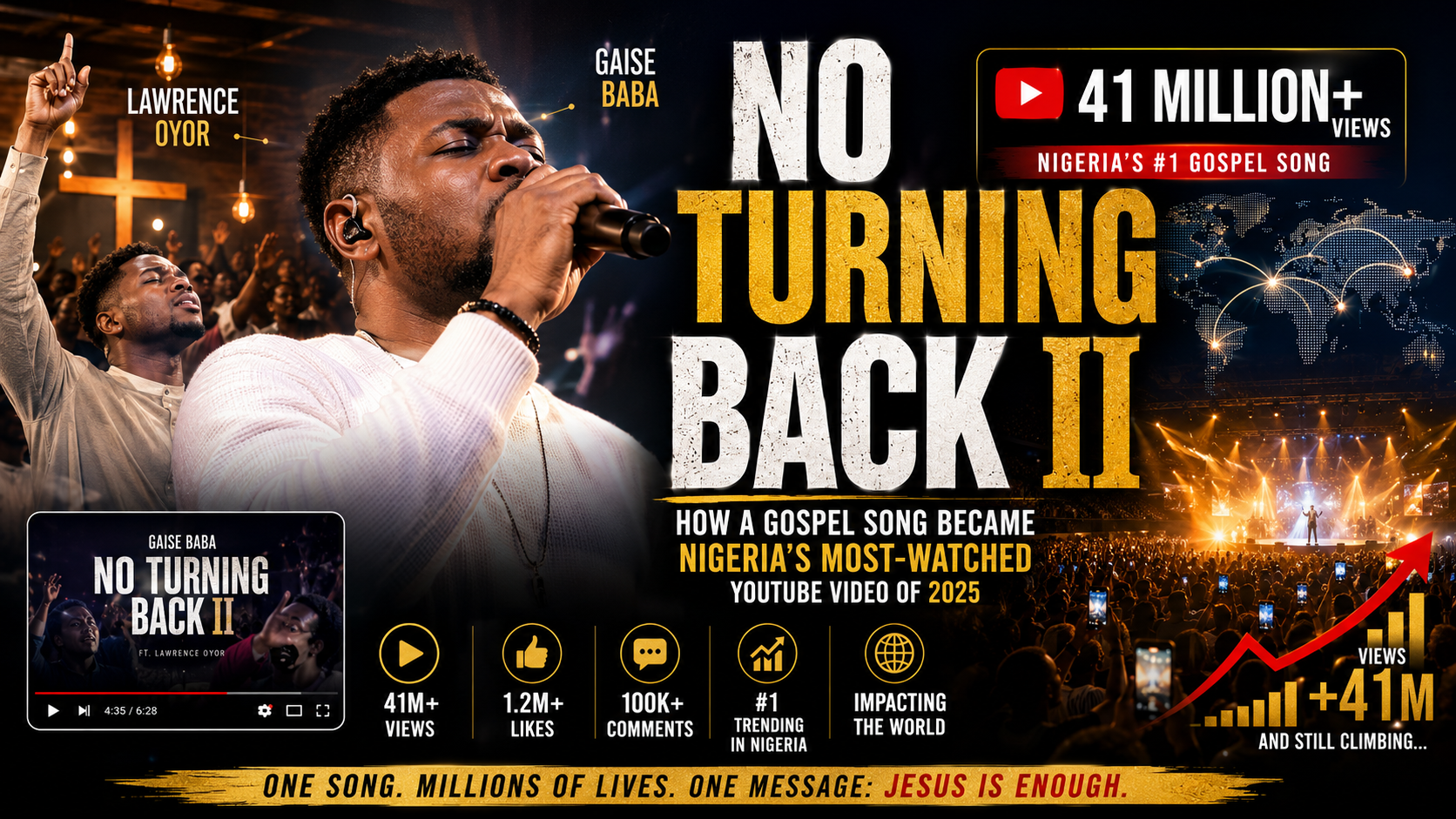
41 million views in six months. Beaten Wizkid, Davido, and
everyone else. Written by a man who nearly quit music entirely. Here's the full
story.
In December 2025, YouTube
released its annual Nigeria rankings — the platform's official record of what
Nigerians watched most over the course of the year. These lists are usually
dominated by Afrobeats. Davido, Wizkid, Burna Boy, the usual names. Nigerian
pop music is one of the most-watched categories on YouTube globally right now,
and its biggest artists regularly produce videos that hit tens of millions of
views within weeks of release.
So when YouTube announced that
the most-watched Nigerian music video of 2025 was a gospel song, it stopped a
lot of people mid-scroll.
Not a mainstream crossover. Not
a gospel-adjacent Afrobeats track with a Bible verse in the hook. A
straightforward, explicitly Christian worship anthem — 'No Turning Back II' by
Gaise Baba featuring Lawrence Oyor — had beaten every secular artist on the
platform to take the top spot. 41 million views in six months. 397,000 likes.
More than 22,000 comments. Shallipopi's 'Laho' came second. Davido and Omah
Lay's 'With You' was third.
Gospel was first.
That's the headline. But the
story behind how it happened is more interesting than the statistic.
Who Is Gaise Baba, Actually
Akinade Ibuoye was born on
August 5, 1986, in Ile-Ife, Osun State, and spent the first decade of his life
there before his family moved to Lagos. His father is a lawyer who wanted the
same career for his son. His mother took the children to church programmes and
quietly built the musical foundation that would eventually redirect everything.
At King's College Lagos he
joined the school choir. At Obafemi Awolowo University he studied Economics,
graduated around 2008, and did his NYSC year in 2009. He started writing songs
in 2004 but didn't take music seriously professionally until 2009. In 2010 he
landed a record deal with Sanctified Records. In 2011 he released his
self-titled debut album, a fusion of Afrobeat, gospel, Yoruba, English, and
Pidgin that introduced him as a conscious artist with a style that didn't quite
fit any existing category.
Then, like many artists with a
debut that doesn't crack the mainstream immediately, he spent years in a space
that he's described honestly in interviews: his music was purposeful but it was
hard going. He nearly walked away. In his own words, he had reached a point of
seriously considering a regular 9-to-5 job because the money wasn't coming. He
had a record deal in his twenties and still stayed broke. His music was with a
purpose, as he put it — it just wasn't the kind of purpose that translated
quickly into commercial success.
He didn't quit. He built
instead. He founded LightOut, a high-school outreach programme that has now
reached over 25,000 teenagers across Nigeria through music and art. He created
ARAMANDA, an Afro-Urban Christian music and arts festival described as the
biggest Christian party of the year in Nigeria. He launched Lounge464, a
monthly intimate performance residency in Lagos. He did a Berklee College of
Music diploma in Music Business, which tells you something about how seriously
he thought about the infrastructure behind what he was trying to build, not
just the music itself.
He also kept making music. And
in 2024 he started working on something with Lawrence Oyor.
Lawrence Oyor and the David Generation Church
Lawrence Oyor is the pastor of
David Generation Church — which Gaise Baba publicly called 'that warrior
congregation' in his response to the YouTube announcement. If you've spent any
time in Nigerian gospel circles in the last few years, you've heard Lawrence
Oyor's name attached to several of the genre's most energetically received
worship moments.
His vocal delivery is
specifically built for the kind of gospel that requires full physical
commitment from a room. There's a reason churches use his music for exactly the
moments when a congregation needs to move from passive attendance into genuine
participation. He and Gaise Baba had worked together before 'No Turning Back
II', and when they came together for this collaboration, what emerged was
something that combined Gaise Baba's Afro-fusion production instinct with
Oyor's ability to carry a room through pure conviction of delivery.
The song was released on May
16, 2025. Its central message is exactly what the title says: a declaration of
irreversible commitment. I have decided. There is no going back. The crowd vocals
that appear on the chorus — giving life to the idea of Godly devotion being too
interesting to turn back on, as OkayAfrica described it — are the detail that
made it TikTok-native before it became a church staple. You could clip six
seconds of that chorus and it worked perfectly on a phone screen. Which is
exactly what millions of people did.
How a Gospel Song Beat Everyone Else
The obvious question is why
this one. Nigeria produces an enormous volume of gospel music. Many of those
songs are genuinely excellent. Most of them don't come within a distance of 41
million views. So what happened here specifically?
Part of it is timing. 2025 was
the year that the data confirming Nigerian gospel's streaming surge stopped
being a niche observation and started being something mainstream media couldn't
ignore. Gospel music streams across sub-Saharan Africa had grown 50% year on
year. YouTube's own data showed that over 70% of watch time on Nigerian channel
content was now coming from outside Nigeria — which meant that a gospel song
that resonated locally was simultaneously reaching a global diaspora audience
in a way that would have required international label infrastructure a decade
ago.
Part of it is TikTok. 'No
Turning Back II' became a TikTok smash before YouTube caught up with the
numbers. The crowd vocal hook was tailor-made for the platform — short,
singable, theologically direct, rhythmically infectious. It generated an
amapiano-influenced sound that younger Nigerian Christians could engage with as
music, not just as ministry. That's the specific combination that has been
producing gospel crossover moments in 2025: spiritual conviction with rhythmic
energy that doesn't require you to be in a church context to engage with it.
And part of it is the message. 'No
Turning Back' is not a complicated declaration. It's a line that every
Christian who has ever wavered knows from the inside. Not because they're
faithless, but because commitment in real life is harder than commitment in
theory. The song doesn't address that difficulty philosophically. It just
asserts the decision loudly and repeatedly. For a lot of listeners, especially
younger ones, hearing it felt less like being preached at and more like being
cheered on.
Simple Obedience — Gaise Baba's Own Words
When YouTube announced the
milestone on Instagram, Gaise Baba responded in the comment section. His exact
words: 'Big shout-out to Pastor Lawrence Oyor and that warrior congregation of
David Generation Church. See what the Lord has done with our simple obedience.
Of a truth, we shift the culture.'
Simple obedience. That phrase
is doing a lot of work for someone who spent years nearly quitting the career
that produced this song. It's not false modesty — it's a specific theological
claim about how he understands what happened. He didn't engineer a viral
moment. He made something he believed in, with people he trusted, and released
it. The 41 million views were not the goal. They were the byproduct.
That posture is consistent with
every account of how he's built his career. The LightOut initiative reaching
25,000 teenagers didn't start with a strategy for scale. The ARAMANDA festival
didn't launch with investor backing and a five-year growth plan. These were
things he built because he believed they needed to exist, in the immediate
community in front of him, and then watched them grow beyond what he'd
initially imagined. 'No Turning Back II' followed the same pattern.
By February 2026, the song had
crossed 50 million YouTube views — 278 days after release, as Gaise Baba noted
in his milestone post. He specifically mentioned the song's connection with
children: 'A big thank you to everyone, especially the precious little children
who this record has made such a deep connection with and who have played a huge
role in making it the living classic it already is.' The animated versions
created for younger viewers, the TikTok challenges that parents and kids were
doing together — these were not part of an original content strategy. They
emerged because the song found an audience the creators hadn't specifically
targeted.
What It Actually Means for Nigerian Gospel
I want to be careful not to
overstate this. One song topping a YouTube chart, even Nigeria's chart for a
full year, doesn't permanently change the commercial landscape of Nigerian
music. Afrobeats will continue to dominate the overall numbers. The major label
infrastructure, the global distribution deals, the streaming promotional
budgets — those still largely sit on the secular side of the industry.
But the 2025 result is a data
point that was not available before. Gospel music has now produced Nigeria's
most-watched YouTube video of the year. Not a gospel-adjacent pop track that
happened to mention God in the hook. A worship song. One that came from a
collaboration between an artist who spent years building community-based
platforms while the mainstream ignored him, and a pastor whose congregation
became part of the song itself.
That matters for a specific
practical reason: it changes what record labels, streaming platforms, and
booking agencies can say when they tell gospel artists that the ceiling for
this genre is lower than for secular music. The ceiling argument just got
harder to make. Not impossible to make — but harder.
For Gaise Baba specifically,
what the 2025 record represents is something he's been building toward since
2004 when he started writing songs in Ile-Ife. Not fame, exactly. Not
commercial dominance. More like proof that the lane he was building — Afro-gospel
with genuine cultural weight, street-penetrating as he's described it, taking
Christian content to the marketplace rather than keeping it inside church
buildings — was a real lane and not a niche experiment.
It took about twenty years to
prove. But here it is, sitting at the top of a list that Wizkid and Davido
couldn't reach this time around.
'See what the Lord has done
with our simple obedience.' He said it himself, and I don't think there's a
better way to put it.
Were you
one of the 41 million who watched this in 2025? Or is this the first time
you're hearing the story behind it? Drop your reaction in the comments — and if
you have a story about where you first heard the song, I want to read it.
Discussion (0)
No comments yet. Be the first to share your thoughts!