The Real Story Behind Tasha Cobbs Leonard's "Break Every Chain"
BY ADMIN USER
Published Jun 20, 2026
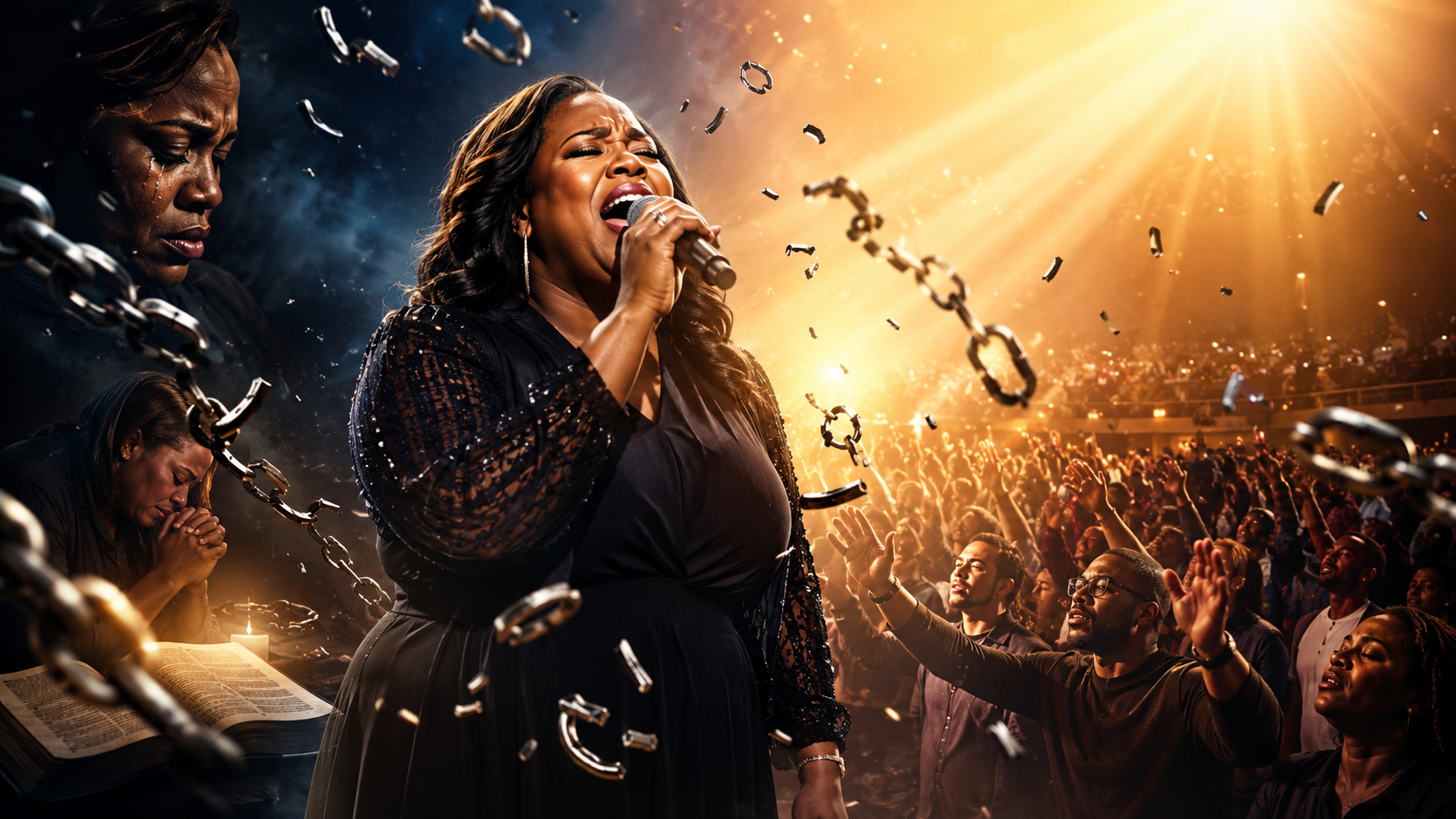
A worship anthem that began with one woman's private battle with
depression — and ended up in churches across the entire world.
There are songs that arrive at
just the right time, and then there is 'Break Every Chain.'
You've heard it. Probably many
times, in many settings — thundering from a church sound system, playing softly
in someone's car, or lifting suddenly from a phone screen on a quiet afternoon
when someone needed exactly those words. 'There is power in the name of Jesus
to break every chain.' It is one of those worship songs that seems to find
people rather than the other way around.
But the full story behind how
this song went from a small indie worship collective in Knoxville, Tennessee to
the hands of a young woman battling depression in Georgia, and then from that
personal breakthrough to stadiums, Grammy stages, and church services on six
continents — that story is worth telling slowly. Because the details matter.
And because the details are, in the best possible way, not what most people
expect.
It Didn't Begin With Tasha
This is where the story
surprises people.
'Break Every Chain' was written
by Will Reagan — a worship musician based in Knoxville, Tennessee who was part
of a collective called United Pursuit. The song appeared on an album called In
the Night Season, released in 2009. United Pursuit was not a mainstream gospel
act. They were an indie folk worship collective, rooted in a community house in
downtown Knoxville where a group of friends had gathered to worship and build
something together. Their sound was acoustic, unhurried, far removed from the
polished production of mainstream gospel.
The song sat within that small
community for a few years. Jesus Culture covered it in 2011, which introduced
it to a broader contemporary Christian audience. But it had still not found its
largest moment.
That moment was waiting for
Tasha Cobbs.
A Small Town, a Bishop Father, a Hidden Battle
Natasha Tameika Cobbs was born
on July 7, 1981, in Jesup, Georgia — a small town that most people outside the
American South wouldn't be able to place on a map. Her father was Bishop Fritz
Cobbs, the founder of Jesup New Life Ministries. Her mother, Lady Bertha Cobbs,
was a pastor in her own right. Tasha grew up inside the church the way some
children grow up inside a family business — it was everything, everywhere, all
the time.
She didn't sing in public until
she was fifteen, and even then only out of necessity: she was directing a
community choir when the scheduled soloist didn't show up. The moment she
opened her mouth, something became clear that changed the trajectory of her
life.
In 2006, she left Jesup for
Atlanta, joining the dReam Center Church of Atlanta under Pastor William
Murphy. Murphy became a spiritual father figure to her in ways that mattered
deeply. He would introduce her publicly, saying 'This is my daughter, Tasha
Cobbs, and she's a bridge to the nations.' She didn't fully understand what he
meant. Not yet.
What was happening underneath
the surface during those years, mostly hidden from anyone outside her inner
circle, was a battle with depression and anxiety so severe that it reshaped how
she understood herself and her faith. In 2016, Cobbs Leonard publicly revealed
that she had been diagnosed with depression in 2007 — the same period when she
was faithfully leading worship every Sunday, managing the Worship and Arts
Department at dReam Center, and appearing by all external measures to be
thriving.
That is the hidden layer
beneath this story. A woman standing before congregations week after week,
leading people into the presence of God, while privately drowning.
The Car Ride That Changed Everything
In 2012, Tasha Cobbs was
travelling with her ministry team when 'Break Every Chain' came on — Will
Reagan's version, the one recorded three years earlier in Knoxville by a
worship collective most of her audience had never heard of.
She has described what happened
next in her own words, on Sadie Robertson Huff's podcast: 'I was just in this
season — it was a very, very dark season for me, just struggling with
depression and anxiety really, really, really bad. And I remember this song
came on and the first words — There is power in the name of Jesus to break
every chain — and I felt like my spirit just began to receive these words and
walls started to crumble that I had built up over the years.'
That moment in a moving
vehicle, somewhere on a road in America, with a song playing through a speaker
— that is the moment the song became what it became. Not when it was written.
Not when it was recorded. When Tasha Cobbs heard it and her walls came down.
She decided to record it.
Grace and the Grammy
The album Grace was recorded
live on June 14, 2012, at Northview Christian Church in Montgomery, Alabama. It
was produced by VaShawn Mitchell and released through EMI Gospel in February
2013. 'Break Every Chain' was the lead single, featuring guest vocals from
Timiney Figueroa of Hezekiah Walker's Love Fellowship Crusade Choir.
The song spent seven weeks at
the top of Billboard's Gospel Airplay chart. It went platinum. It reached
number one on the Hot Gospel Songs chart. Grace itself climbed to number one on
the Top Gospel Albums chart and crossed over to number 61 on the broader
Billboard 200 — a rare achievement for a debut gospel project from a largely
unknown artist.
At the 56th Annual Grammy
Awards in 2014, Tasha Cobbs won Best Gospel/Contemporary Christian Music
Performance for 'Break Every Chain.' She became, almost overnight, one of the
most recognised voices in gospel music. JET Magazine. Radio stations across the
United States. Churches that had never heard her name twelve months earlier
were now building entire worship sets around her song.
She went to the Grammy ceremony
without her father.
The Last Conversation
Bishop Fritz Cobbs died in
2014, just days before the Grammy Awards ceremony where his daughter was
nominated for the first time.
In the weeks before he passed,
knowing he would not be well enough to travel to Los Angeles, he told her:
'Daddy's not going to be with you in LA, but I want you to go anyway.'
She went anyway. She won. She
stood on that stage holding a Grammy, with her father's last words in her ears
and his absence everywhere around her.
Years later, that conversation
became the seed for her first book, Do It Anyway: Don't Give Up Before It Gets
Good, published in 2024. The title comes from what he said. The book opens up
about the depression, the anxiety, the years of private struggle, and the
miscarriage she and her husband Kenneth Leonard experienced after they married
in 2017. It is a record of someone who kept going not because the circumstances
were manageable, but because she had decided — as an act of will, not of
feeling — to do it anyway.
What Came After
Tasha Cobbs Leonard's career
after 'Break Every Chain' is, statistically, extraordinary.
Five of her projects have
reached number one on the Top Gospel Albums chart. Her 2017 album Heart.
Passion. Pursuit. made history in its first week, generating more streams than
any gospel album in history to that point — 3 million streams in seven days. It
became the longest-running number one gospel album for over three years. She
has won 3 Grammy Awards, 12 Dove Awards, 16 Stellar Awards, and 3 Billboard
Music Awards.
She co-pastors The Purpose
Place Church in South Carolina with her husband. She mentors 2,000 people
through her iLead Escape ministry programme. She adopted a son, Asher, in July
2021, adding to her blended family of six children across four.
In 2025, she released an album
simply titled TASHA — featuring collaborators including John Legend and Lecrae
— a project that marked another chapter of creative expansion, following the
rawness of writing and releasing a memoir, stripping back the carefully managed
public image and letting people see the full picture.
The Song Keeps Going
'Break Every Chain' is one of
those songs that has outgrown any single version of itself.
It began as Will Reagan's
quiet, acoustic declaration in a Tennessee worship community. It was covered by
Jesus Culture and carried into contemporary Christian spaces. Then Tasha Cobbs
heard it in a car during her darkest season and recognised something in it that
the rest of the world needed to recognise too. She recorded it with full gospel
production, put it in front of an audience that had never heard it, and watched
it become one of the defining worship songs of the 2010s.
The song has been translated
into dozens of languages. It has been sung in prison chapels, hospital wards,
recovery groups, and cathedral services. It played in churches during the
COVID-19 pandemic, when congregations were desperate for any language of
breakthrough that still felt true.
The reason it keeps working is
the same reason it worked for Tasha Cobbs in that car in 2012. It doesn't
promise that the chains are already gone. It declares that there is power to
break them — which is a different thing entirely. It is a song for people who
are still in the middle of something. Which, at any given moment, is most of
us.
What This Story Is Really About
There's a version of this story
that focuses on the Grammy, the chart positions, the streaming numbers, the
sold-out venues. That version is accurate but incomplete.
The fuller version is about a
bishop's daughter from a small town in Georgia who spent years leading worship
publicly while privately fighting for her mental health. Who heard a song in a
car that cracked something open in her. Who recorded it not as a career move
but as a testimony. Who lost her father days before the biggest night of her
professional life and went to the ceremony anyway because he told her to. Who
spent the next decade being more honest — incrementally, painfully, publicly —
about the gap between what ministry looks like from the outside and what it
feels like on the inside.
Tasha Cobbs Leonard has 3
Grammys. She has a platinum single that has played in churches on six
continents. She has a memoir about depression and miscarriage and choosing to
keep going.
Of everything on that list, the
memoir might be the most important. Because the song broke chains. But the
story behind the song tells you that the person singing it was in chains too —
and that is exactly why it hit as hard as it did.
The most powerful worship comes
from the most honest places. Tasha Cobbs Leonard has spent a career proving
that.
Where
were you the first time 'Break Every Chain' really got to you? And did knowing
Tasha's story change the way you hear it? I'd love to know in the comments.
Discussion (0)
No comments yet. Be the first to share your thoughts!