Tope Alabi: The Yoruba Gospel Icon Who Never Needed English to Go Global
BY GMUSICVIBES EDITORIAL
Published Jun 30, 2026
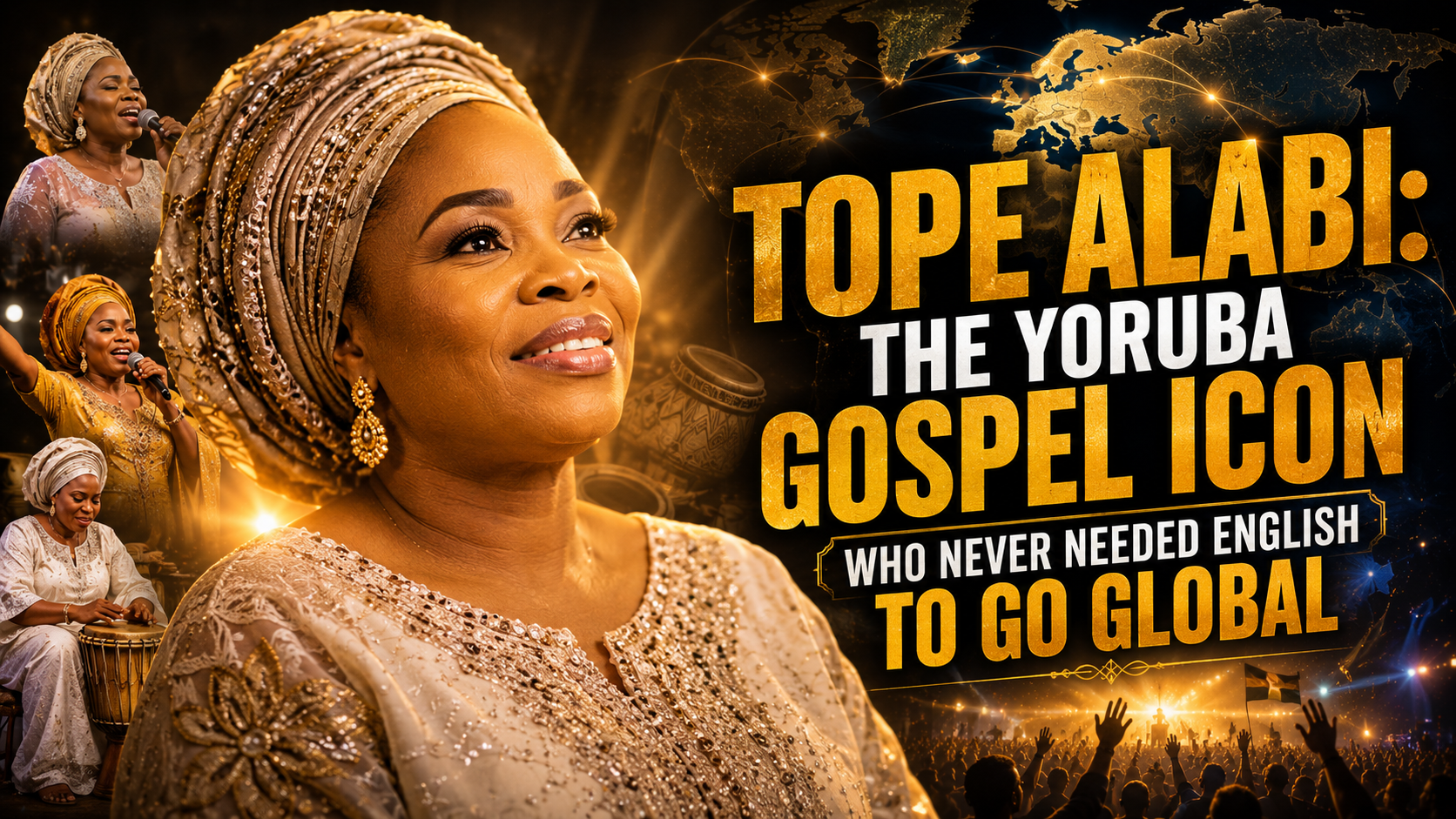
She built one of Africa's most influential gospel ministries
entirely in her mother tongue — and proved the language was never the barrier
people assumed it was.
There's a specific kind of
artist whose influence is so total within their own cultural sphere that people
outside it often have no idea how significant they actually are. Tope Alabi is
that artist.
Ask almost any Yoruba-speaking
Christian, anywhere in the world, to name the most important gospel voice of
their lifetime, and her name comes up immediately, usually before anyone
else's. Ask someone outside that specific cultural and linguistic world, and
there's a real chance they've never heard of her at all, despite a catalogue,
an influence, and a ministry that rivals anyone else covered on this blog.
That gap is worth closing.
Because Tope Alabi's story isn't just about one artist's career. It's about
what happens when someone refuses to dilute their cultural and spiritual
identity to chase a wider audience — and ends up building something more
lasting precisely because of that refusal.
A Choir Kid Who Became an Actress First
Patricia Temitope Alabi was
born on October 27, 1970, in Lagos State, the only daughter in a family of
three children, with roots in Yewa, in the Imeko-Afon area of Ogun State. Music
found her early — she joined her local Catholic church choir at just seven
years old, and by her own account, one of her earliest memories is of her
mother singing around the house, hoping her daughter would one day become a
minister.
But Tope's path to gospel music
ran through an unlikely detour: acting. After completing secondary school at
Oba Akinyele Memorial High School in Ibadan and earning a Higher National
Diploma in Mass Communication from the Polytechnic of Ibadan in 1990, she
briefly worked as a correspondent for the Nigerian Television Authority. Then,
in 1994, she joined the Alade Aromire Theatre Group, hoping to build a career
as a thespian.
That decision changed
everything, though not in the direction she expected. Within the Yoruba film
industry, Tope discovered an extraordinary gift for composing soundtracks —
music that didn't just accompany a film's emotional beats but actively shaped
them. She became, in the words of people who worked alongside her during that
era, the 'go-to person' for Yoruba movie soundtracks. Over the course of her
career, she has composed over 350 — by some accounts as many as 1,000 —
soundtracks for Yoruba-language films, establishing her years before her gospel
career began as one of the most prolific and recognisable musical voices in an
entire film industry.
The Divine Calling and the Uncommon Favour
Tope Alabi describes the shift
from soundtrack composer to gospel minister in explicitly spiritual terms — a
divine calling to the singing ministry that arrived around the year 2000,
redirecting a career that had, until then, been built primarily around
entertainment.
Her debut gospel album, Ore ti
o Common — meaning 'Uncommon Favour' or 'Uncommon Grace' — was released in 2000
and became an immediate sensation. The title track had actually existed first
in a non-gospel, makossa-influenced version; it was the gospel reworking of
that same song, built on the same infectious rhythm but redirected entirely
toward worship, that caught fire across Nigeria. The album didn't just launch a
career. It established, in a single release, the template that would define her
ministry for the next two decades: traditional Yoruba rhythm and proverb, fused
seamlessly with explicit, often prophetic Christian lyrics.
What followed was one of the
most productive and influential discographies in African gospel music. Iwe Eri
in 2003. Agbara Nla and Agbara Re Ni. Agbara Olorun. Kokoro Igbala. Angeli Mi. Mo
Ri'Yanu. Agbelebu. Alagbara. Oruko Tuntun. Yes and Amen in 2018. Each album
reinforced the same fundamental conviction: that the deepest spiritual truths
could be communicated most powerfully not despite the Yoruba language and its
cultural texture, but specifically through it.
A Sound Nobody Else Was Making
What makes Tope Alabi's music
distinctive isn't simply that she sings in Yoruba — plenty of artists have done
that. It's the specific way she fuses traditional and contemporary elements
into something that feels neither like a folk relic nor a Western import, but
genuinely its own thing.
She has described her own
musical approach as drawing on salsa, makossa, hip-hop, and traditional Yoruba
rhythms simultaneously, all held together by storytelling techniques and
proverbs lifted directly from everyday Yoruba speech and wisdom traditions. Her
lyrics frequently come, by her own account, from dreams and direct spiritual
revelation — she has been described by many in Nigerian gospel circles as a
prophetic minstrel, someone whose songs function less like compositions and
more like messages received and then delivered.
This combination is part of why
her music resonates so deeply with listeners who grew up immersed in Yoruba
culture, in a way that can be difficult to fully translate to outsiders. A
proverb that takes a paragraph to explain in English lands instantly,
viscerally, for someone who grew up hearing it from their grandmother. Tope
Alabi's entire catalogue is built from exactly that kind of cultural shorthand,
repurposed for worship.
Mentorship, Marriage, and a Concert Given Away for Free
Tope Alabi is married to Soji
Alabi, a studio engineer and producer who has worked alongside her for the bulk
of her career, doubling as her manager. Speaking about their marriage in a 2013
interview, Soji described how Tope's presence in the studio had drawn him in
long before the relationship became romantic — 'anytime she came around in the
studio, I felt good,' he said, adding that even after more than a decade of marriage,
he had no regrets. The couple has two daughters, Ayomiku and Deborah, alongside
a son, with Ayomiku — a graduate of Bowen University — also pursuing music in
her own right.
Together, Tope and Soji built
more than a recording career. They founded Gospel Vibes, their own music
production outfit, and the Mardebra Comforter Foundation, an organisation
supporting underprivileged communities in Nigeria. Every February, the couple
hosts the Praise the Almighty concert in Lagos, an event that draws enormous
crowds — and one Tope has been explicit about never monetising. 'Me and my
husband don't organise the concert to gain anything, other than for people to
be blessed,' she told Vanguard in 2019. 'It is a way of giving back to God...
that is why it is free.'
That decision echoes a pattern
that shows up repeatedly across this blog's coverage of major gospel figures —
Nathaniel Bassey's refusal to monetise the Hallelujah Challenge being the
clearest parallel. There appears to be a recurring instinct among gospel
music's most significant figures to deliberately wall off at least one major
initiative from the commercial logic that governs the rest of the industry, as
a kind of standing reminder, to themselves as much as to anyone watching, of
what the ministry is actually for.
Beyond the concert, Tope and
Soji also built 'At Home With Tope Alabi,' a mentorship initiative offering
younger gospel artists hands-on guidance in songwriting, composition, and
performance. She has worked directly with TY Bello — most notably on the 2019
spontaneous worship project The Spirit of Light, which produced the widely
loved track 'Logan Ti O De' — as well as with Mike Abdul, Tim Godfrey, and
numerous other artists across Nigerian gospel's broader landscape.
The Controversies She Hasn't Avoided
A career this long and this
publicly visible has not been without genuine controversy, and an honest
profile has to include it rather than skip past it.
In 2021, Tope Alabi drew
significant public criticism over comments she made regarding fellow gospel
artist Adeyinka Alaseyori's song 'Oniduro Mi.' Her remarks were widely
interpreted as questioning the song's theological accuracy, specifically around
how it referenced a divine name in Yoruba, and the backlash from fans on both
sides became significant enough that she later issued a public apology,
clarifying that her intent had been to encourage deeper spiritual understanding
rather than to create division.
A separate controversy emerged
in 2023, when Tope Alabi used the traditional Yoruba phrase 'Aboru Aboye
Abosise' in a song performed live — a phrase commonly associated with Ifa
traditional religious practice and priesthood. Critics, including some
Christian commentators, characterised the choice as inappropriate, even
idolatrous, for a gospel artist to include. Alabi defended the phrase as simply
ordinary Yoruba language expressing gratitude and safe arrival, not a religious
endorsement of Ifa practice specifically.
Both controversies point to the
same underlying tension that runs through Tope Alabi's entire body of work: the
genuinely difficult question of where the line sits between embracing a
cultural heritage's language and imagery, and unintentionally importing
meanings that conflict with explicitly Christian theology. There's no clean
resolution to that tension, and reasonable, sincere Christians land in
different places on it. What's notable is that Tope Alabi has never simply
avoided the tension by retreating into safer, more generic gospel language.
She's stayed in the harder, more culturally specific territory, even when it's
cost her some public goodwill along the way.
A separate and more personal
allegation surfaced regarding her relationship with her late spiritual mentor,
Pastor Ajanaku, who died in 2013. Tope Alabi has publicly and consistently
denied any inappropriate relationship, describing their connection as purely
spiritual and professional, and noting that the two had fallen out years before
his death.
A Hymnal for a Generation That Forgot Hymns
One of Tope Alabi's less
publicised but genuinely significant contributions is her work compiling and
releasing a hymnal — by her own description, the first compendium of originally
composed hymns produced in a generation. The project reflects a specific
concern she's spoken about: that younger Christians, immersed in contemporary
worship's faster tempos and more produced sound, were losing touch with the
older hymn tradition's particular depth and patience.
It's a small project relative
to her broader discography, but it says something consistent about her approach
throughout her career. Tope Alabi has never simply chased whatever was most
current. She's repeatedly reached backward — into proverb, into traditional
rhythm, into the hymn tradition itself — convinced that older forms still have
something essential to offer a generation tempted to discard them entirely in
pursuit of whatever sounds newest.
International Recognition, Built on a Foundation That Never Compromised
In recent years, Tope Alabi's
influence has been formally recognised well beyond Nigeria. She has received a
Presidential Lifetime Achievement Award in the United States for over 4,100
hours of community service, and in 2023 was honoured with a congressional
proclamation by a U.S. Congresswoman in recognition of her Praise the Almighty
concert's cultural and spiritual impact.
What makes that international
recognition genuinely notable is what it didn't require. Tope Alabi never
recorded a crossover English-language album to chase wider Western audiences.
She never diluted the specifically Yoruba cultural and linguistic core of her
ministry to make it more broadly palatable. The recognition came to the work as
it already existed, in the language it had always been made in, built for the
audience it had always been built for first.
What Her Career Actually Proves
There's a temptation, when
thinking about global reach in gospel music, to assume that English is simply
the price of entry — that an artist has to write and sing in the world's
dominant commercial language to ever be taken seriously beyond their immediate
region. Tope Alabi's entire career is a quiet, decades-long argument against
that assumption.
She built one of the most
influential gospel ministries in African Christianity almost entirely in
Yoruba, mentored a generation of younger artists through it, and ended up
recognised by U.S. government officials and international audiences anyway —
not because she eventually translated her work into something more universally
accessible, but because the work itself, rooted unapologetically in a specific
language and culture, turned out to be universal in exactly the way it already
was.
That's worth remembering for
anyone building something in this space who assumes their specific cultural
voice is somehow a limitation rather than the actual source of their
distinctiveness. Tope Alabi never needed English. She needed only to keep
writing, in the language she'd always known, about the God she'd always served
— and let the rest of the world eventually find its own way to her.
If you
grew up with Tope Alabi's music, what song or album meant the most to you — and
if you're discovering her through this article, which song would you recommend
someone start with? I'd love to hear in the comments.
Discussion (0)
No comments yet. Be the first to share your thoughts!