Best Nigerian Gospel Wedding Songs for Every Moment of Your Big Day
BY GMUSICVIBES EDITORIAL
Published Jul 16, 2026
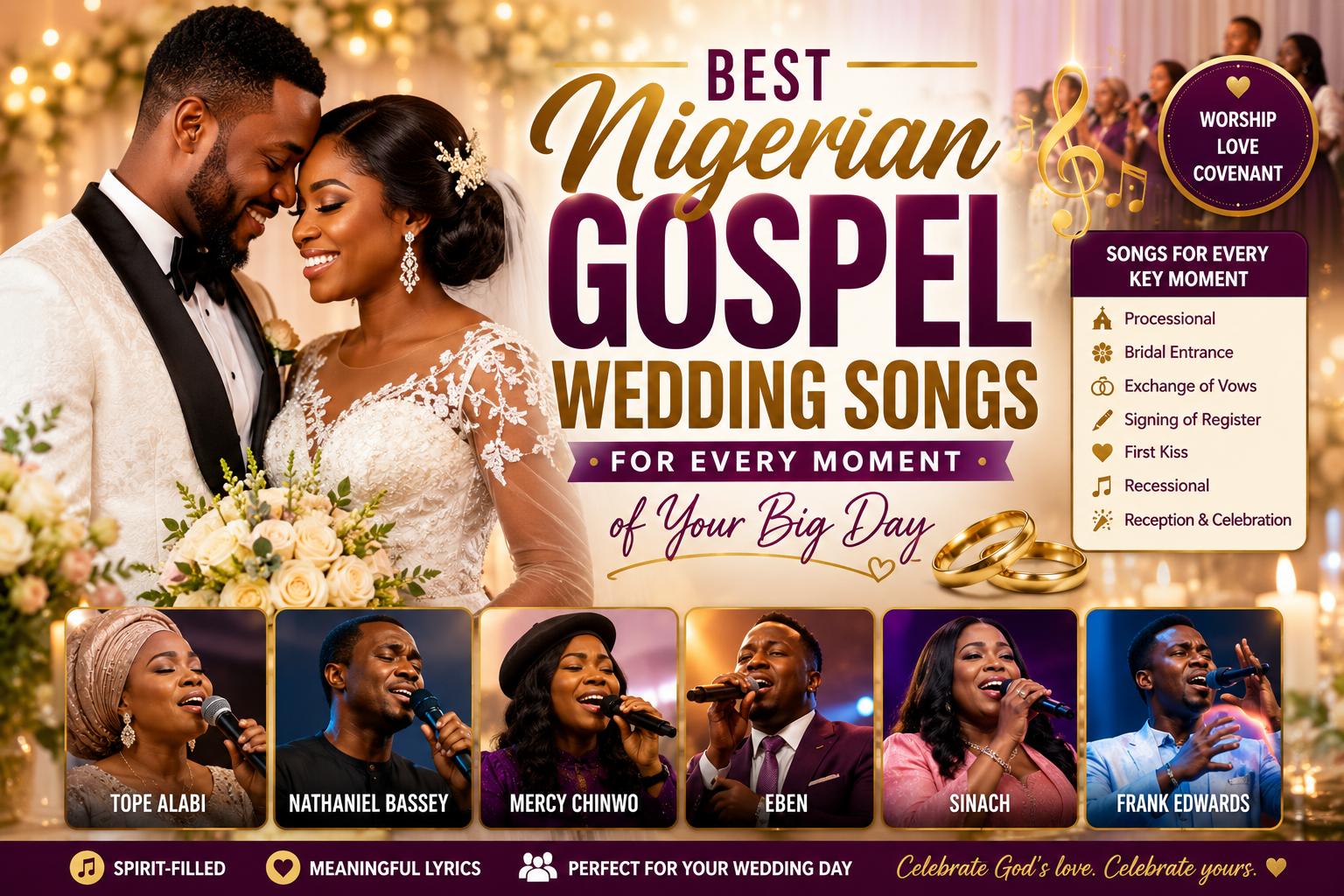
From the church processional to the reception entrance and
everything in between — a practical, honest guide to building a Nigerian
Christian wedding playlist that actually works.
Nigerian gospel wedding music
exists in its own category. It's not secular love songs with Jesus sprinkled
in. It's not old-fashioned hymns that make the reception feel like a memorial
service. The best of it manages to be deeply spiritual and deeply celebratory
at the same time — songs that could hold their own in a church service and
still have your aunties dancing at the reception without anyone feeling like
something inappropriate happened.
This list isn't trying to be
exhaustive. What I'm going for here is practical: songs that work for specific
moments, with honest notes on why, so you can actually use this when you're
building your wedding playlist rather than just reading it and forgetting about
it.
The structure follows the
timeline of a Nigerian Christian wedding: church ceremony first, then
reception. Because the songs that work during the solemnisation are almost
never the right songs for when the couple dances in through the reception
entrance — and I've been to enough weddings where someone got this backwards to
know it matters.
Before the Ceremony Begins: Setting the Room
Most guests arrive 20 to 45
minutes before any Nigerian wedding actually starts. This is not a bug. It's a
feature. And the music playing during that window does more work than most
couples realise.
You want something that creates
reverence without being so solemn it feels like a funeral. Nathaniel Bassey's
instrumental pieces work perfectly here — his trumpet-led worship tracks don't
demand that you stop what you're doing and engage, but they do slowly shift the
room's energy toward something sacred. 'Onise Iyanu' is a solid choice for this
slot. So is his quieter version of 'Imela.' These are songs that work as
background music while also quietly reminding everyone why they're actually
gathered.
Tolu Odukoya's 'God Alone' is
another strong option for the pre-ceremony period — her voice has that
particular quality of sounding like genuine worship rather than performance,
which is exactly the right tone for a room full of people finding their seats
and greeting relatives they haven't seen since the last wedding.
The Processional: Songs for Walking Down the Aisle
Here's where most couples
overthink it. The processional doesn't need to be the most spiritually complex
song you own. It needs to do one job: mark the transition from ordinary time to
something sacred. It should build slightly as the song progresses — because
that moment when the bride appears at the back of the church needs to land.
Sinach's 'Way Maker' has become
something close to the default Nigerian Christian processional and honestly, it
earned that status. The opening is calm enough that the room can settle into
it, and by the time the chorus hits, there's enough lift to match what's
happening visually. If you want something with that same weight but less
ubiquitous, Nathaniel Bassey's 'Ebenezer' does similar emotional work.
Sunmisola Agbebi's 'Adun' is
worth considering if you want something softer and more intimate for the aisle
walk — it's tender in a way that most high-production gospel worship songs
aren't, and it doesn't demand the room's full attention so much as it creates a
gentle atmosphere around the moment.
'Perfect Union' by Sinmidele is
another option I've seen work really well for the bridal entrance specifically.
It's unhurried. It has a quality of certainty about it that matches the mood of
two people who have decided.
During the Ceremony and Vows
This is where you need to be
careful, honestly. A lot of couples pick songs that are personally meaningful but
liturgically wrong for the moment — songs that are theologically about
something completely different from marriage, or that are so energetic they
pull focus from what the officiant is actually saying.
For the period around the vows
themselves, simpler is better. Congregational hymns — actual hymns, the kind
the whole room knows — create something that no professionally performed song
can replicate, because everyone sings together and suddenly the room is
participating rather than watching. 'Great Is Thy Faithfulness' still works
because it's about the character of God rather than the emotion of the moment,
which gives it a stability that more romantic songs don't have.
Tim Godfrey's 'Big God'
featuring Anderson works well for a praise and worship interlude during the
service — it has enough energy to lift the room between liturgical moments
without tipping into full reception mode. Same with 'E Dey Flow' by Moses Bliss
featuring Neeja, though I'd save that one for later in the ceremony rather than
right before the vows.
The First Dance
I want to be honest about
something here: the first dance is the moment where Nigerian Christians most
often feel the pull between two different kinds of music, and it's a real pull.
A fully gospel first dance can
feel slightly awkward if the couple isn't actually worship leaders, because the
song then does something the moment can't quite match. And a secular love song
at a Christian wedding reception makes some guests uncomfortable, which then
makes the couple uncomfortable. The middle path that actually works is gospel
music with romantic themes — songs that are explicitly Christian but written
about love rather than about God's power.
'My Baby' by Remii featuring
Sinmidele is very good for this. It's romantic, it's clearly Christian, and it
doesn't sound like it belongs in a Sunday service. 'IFE (In Love)' by Tchella
gives you a similar register — warm, intimate, more celebration of a love that
God gave than declaration of God's greatness. Both are built for exactly this moment.
Timi Dakolo's 'Iyawo Mi' also
belongs in this conversation. It's gospel-influenced rather than
straightforwardly gospel, but the influence is audible and the sentiment is
exactly right for two people having their first dance. It has become a modern Nigerian
wedding staple for a reason.
The Reception Entrance
Now we're in completely
different territory. The reception entrance is not a spiritual moment. It's a
celebratory one — the couple has made their vows, signed their documents, and
is now entering their own party. The music for this moment should make it
impossible for anyone in the room to stay seated.
Gaise Baba's 'No Turning Back
II' featuring Lawrence Oyor is the obvious pick right now and has been since it
became Nigeria's most-watched YouTube music video of 2025 with over 41 million
views. It's hard to argue with a song that has that much proven energy behind
it. The moment it starts, anyone who has heard it before knows exactly what it
means and starts moving.
'E Dey Flow' by Moses Bliss
featuring Neeja is another strong entrance song — it has that combination of
recognisability and lift that makes a room erupt rather than gradually warm up.
Same energy: you want the couple walking in to something the room already knows
and loves.
If you want to do something
slightly less obvious, 'Bigger' by Moses Bliss still works beautifully for this
moment. The opening is dramatic enough to signal that something is about to
happen, and by the time the chorus comes in, the room has already committed.
Background Music for Dinner and the Reception Meal
This slot gets ignored in most
wedding planning conversations and then causes problems on the day. The dinner
period is usually 45 minutes to an hour, which is a long time for bad
background music to wear on people.
You want something with the
right volume and texture — audible enough to fill the silence, not so demanding
that it interrupts conversation. Johnny Drille's 'Count My Blessings' is very
good for this: it has a folk-influenced softness that sits underneath
conversation rather than competing with it. 'Promise Keeper' by Sounds of Salem
has a similar quality.
Mercy Chinwo's slower tracks
work here too. 'Excess Love' is soft enough in its original version to serve as
background, though honestly it's so well-known now that it tends to pull
people's attention rather than sit under it — something to factor in depending
on your guest list.
The Dance Floor: What Actually Gets Nigerians Up
Let me be direct: if you only
want gospel music at your reception, you need to choose specific gospel songs
that have the rhythmic energy to function as dance floor material — because not
all gospel songs do this, and a gospel wedding playlist full of worship songs
is going to empty your dance floor by 9pm.
The Afro-gospel songs are your
answer here. 'No Turning Back II' already mentioned, but also Tim Godfrey's
more uptempo material, Moses Bliss's Afrobeats-inflected tracks, and songs from
the current wave of artists like Lawrence Oyor and Gaise Baba who are
explicitly writing gospel music with the rhythmic energy of mainstream Nigerian
pop.
'Shugah' by Angeloh and
GreatMan Takit has become a popular wedding song specifically because it's a
Christian love song that sounds like contemporary Afrobeats. Folabi Nuel's work
hits similarly. These are artists writing music for exactly the context you're
trying to fill: a room of Nigerian Christians who want to celebrate without
feeling like they've crossed a line.
And if your DJ is good — which,
at a Nigerian wedding, they should be — they know how to sequence these. The
gospel material doesn't have to carry the entire night. What it needs to do is
make the first hour feel spiritually grounded, so that when the evening opens
up into celebration, the foundation has been clearly established.
One Practical Note on Working With Your DJ
Tell your DJ specifically which
songs are non-negotiable and at which moments. Not a general vibe direction.
Actual song names with actual timestamps in the ceremony and reception.
Nigerian wedding DJs are skilled at reading a room and responding to it, but
they cannot read your mind, and a 'just keep it gospel and upbeat' instruction
will produce a playlist that reflects the DJ's taste rather than yours.
Also: send your DJ a playlist
at least two weeks before the wedding, not two days before. They need time to
source songs they might not have, check audio quality, and build transitions
that don't jar. The difference between a wedding DJ who has had three weeks
with your playlist and one who got it the night before is audible within the
first fifteen minutes.
The music is never just the
music at a Nigerian wedding. It's the thing that tells everyone what kind of
evening this is going to be. Get it right and guests will talk about it for
years. Get it wrong and they'll talk about it for different reasons.
What was
the gospel song at your wedding — or the one you're planning to use? Drop it in
the comments. And if you're a DJ who has strong opinions about what actually
works versus what people think will work, I genuinely want to hear that too.
Discussion (0)
No comments yet. Be the first to share your thoughts!